Showing posts with label writing. Show all posts

Wednesday, 16 January 2013

The Count of Monte Cristo

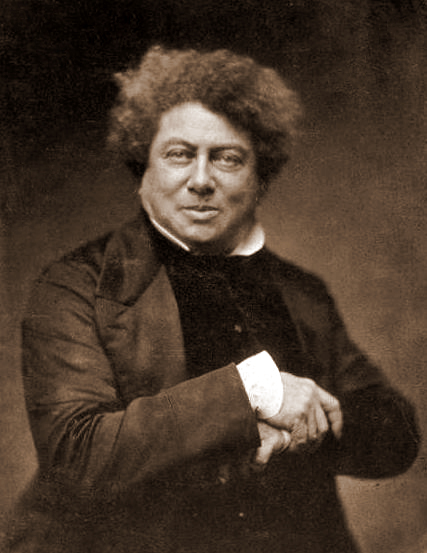
Alexandre Dumas (1802-70). This image was taken by Nadar in 1855.

I've just recently finished The Count of Monte Cristo by Dumas. I thought it was absolutely brilliant & thoroughly recommend it, especially the Penguin Classics edition (ISBN 9780140449266), which is what I read. This is translated by Robin Buss & has the great advantages of being unabridged & unexpurgated. I want to quote a bit of dialogue from near the end of the novel. It doesn't give any of the plot away. It is a conversation between the Count & his friend Morrel. The latter speaks first:


" 'Count, you are an encyclopedia of all human knowledge, & you strike me as someone who has come down from a more advanced & wiser world than our own.'
'There is some truth in that, Morrel,' the Count said with a melancholy smile that transfigured his face. 'I have come from a planet called sorrow.'"


- Ch.117 'October the Fifth', p.1235

Monday, 14 November 2011

5 Guidelines for English Prose Style

"The great enemy of clear language is insincerity."

- George Orwell, Politics & the English Language, in Inside The Whale & Other Essays, p.154


Here are 5 guidelines for English prose style:


1. Make sure your choice of words and syntax accurately reflect your meaning. This is easily said, but it is basic, and a large part of the whole craft of writing clearly lies in understanding and applying this rule.


2. Spell properly. The dictionary is your invaluable companion in this and in Rule 1.


3. In general, avoid cliche, except for the purposes of satire.


4. Write in the style appropriate to your subject. For example, to get tremendously worked up over something trivial is absurd. This is a common fault of newspaper columnists, who, with honourable exceptions, are often short of meaningful material to write about.


Which leads to Rule 5:


5. Don't write unless you genuinely have something to say. What follows may sound like a high claim, but writing is a Magical art, and it is abusing that Art to engage in it when you don't really have something to say. It is trading with the Lower Powers, & no good will come of it.


Further reading:


Orwell's Politics & the English Language, where the epigraph comes from, is fundamental to this topic.

Wednesday, 5 October 2011

What is Bulletins for ?

This blog, Bulletins, is quite simply a flexible vehicle for me to express whatever is uppermost in my mind at the time of writing.

Every so often, I return to working intensely on the mosaic in my head, which is my Understanding.

It is also like a collage which is being perpetually rearranged: some elements added, some cut; some emphasised, some diminished; some urgent, some underlying & essential.

The collage is perpetually in flux, sometimes rapidly & sometimes very slowly, but always, to a greater or lesser extent, waxing & waning like the Moon.

<--------------------------------------------->

Holding a thought safely until I can pour it into my notebook is like carrying a cup full to the brim with precious liquid.

<--------------------------------------------->

Here's an image of the process of writing for you. It's what I imagine throwing a pot is like (I've only seen it done, not done it myself.) The lump of clay is your original idea or set of ideas. Throwing it on the potter's wheel is the equivalent of drafting; the slip is your knowledge of grammar and the nuts & bolts of language. Putting the piece of writing into its final form is like firing the pot. Lastly comes publishing the piece, which is like putting the finished pot on display on a stand, for people to make of it what they will.

<--------------------------------------------->

In a magical ritual, an invocation, you perform a certain set of gestures & words. In music, in writing it is exactly the same. Hence these activities have a correspondence to Magic. It's just the same in acting, painting, sculpture - all the Arts. Sport & cooking also. All these activities have resemblances to one another, and all contain the possibility of Magic, as does Magic itself. For a magic ritual badly performed will not succeed.

As regards Sport, think of the similarity between the Magician's circle on the ground within which he or she works, and the diagrams likewise - think of the similarity between that and the markings on a pitch for any given sport.

The ritual also takes place in Time. On this subject Napoleon had an apposite insight, specifically about battles. He said:

All battles are concerned with Space & Time. Space you can regain, Time never.

<--------------------------------------------->

Writing projects Thought through Space & Time. Is that not the fulfilment of a Magician's Dream ?