"1. Now Moses kept the flock of Jethro his father in law, the priest of Midian: & he led the flock to the backside of the desert, & came to the mountain of God, even to Horeb.
2. & the angel of the Lord appeared unto him in a flame of fire out of the midst of a bush: & he looked, &, behold, the bush burned with fire, & the bush was not consumed.
3. & Moses said, I will now turn aside, & see this great sight, why the bush is not burnt.
4. & when the Lord saw that he turned aside to see, God called to him out of the midst of the bush, & said, Moses, Moses. & he said, Here am I.
5. & he said, Draw not nigh hither: put off thy shoes from off thy feet, for the place whereon thou standest is holy ground.
6. Moreover he said, I am the God of thy father, the God of Abraham, the God of Isaac, & the God of Jacob. & Moses hid his face; for he was afraid to look upon God."
- Exodus, Ch.3
.jpg) |
| Endless Rhythm by Robert Delaunay, 1934
Recently, my uncle & aunt sent me this image on a birthday card. It completely knocked me out. It was new to me: Delaunay had been nothing more than a name. I realised that I responded powerfully to the image because it seemed to me to refer to other images which hold great significance for me. I want to tell you what those images are, go into some aspects of what they mean, & show how this illuminates this painting.
This painting is on display in Tate Modern. You can find out more about it on the Tate website here: http://www.tate.org.uk/art/artworks/delaunay-endless-rhythm-t01233
A phrase which I thought of to describe this painting is - a circuit of continous flow. The first image I was reminded of is the Yin/Yang sign:  |
When you look at the 3 circles in Endless Rhythm with the opposition black/white, the similarity is obvious. The yin/yang sign is a description of the fundamental energies in the universe, & how they are in dynamic tension. Yin (black) is considered to be female energy & yang (white) is male energy. You will notice that there is a spot of yin inside the yang, & a corresponding spot of yang inside the yin. The significance of this is that while one side - let us say for the sake of example yin - waxes & waxes to its maximum, there is still a spot of yang remaining which will be the root of the reaction, the point from which in turn yang will wax & wax, until it reaches its maximum, whereupon the remaining spot of yin within the yang comes into play: and so on indefinitely, or at least until the end of the universe, if there is such an event.
A mundane illustration of this idea is if you think of political history in the UK from 1979 to 2000 or so. The Conservatives came to power in 1979, & from a very weak & uncertain beginning became gradually more & more powerful, until they reached a maximum - let's say the Poll Tax riots in the spring of 1990 - after which the became gradually weaker & more decadent, until their terrible defeat in 1997. That was one half of the yin/yang sign. Meanwhile, the other half was also in operation. The Labour Party waned as the Conservatives waxed; Labour dwindled & dwindled until they reached their minimum & then began to recover; although Kinnock lost the 1992 election, the movement to make Labour more centrist was already in train for Tony Blair to accelerate massively after he became leader in 1994. Then Labour's landslide election victory. So by 1997 the UK has seen one full cycle of yin & yang, starting from 1979. The cycle did not start in 1979 of course, there had been many, many such cycles in - in this instance - our history. Nor did it end in 1997. After that, Labour waxed & waxed while the Conservatives correspondingly waned. Note that the symmetry between yin & yang at any given point in the cycle is approximate, not exact. Reality is messy.
Here are three other mundane illustrations of this idea. First, laundry. When you are laundering a set of dirty clothes, after which they will be clean, the clothes you have on are the foundation of the next set of dirty clothes. Second, eating. When you have had enough to eat, when you are satiated, you will eventually become hungry again: it is inevitable. Your hunger will increase gradually from the moment of satiety until hopefully you will be able to satisfy it again. Third, washing. Even if you become as clean as it is physically possible to be - by taking a Turkish bath, say, or a sauna - you will start to become dirty again immediately that cleaning session is over.
Since I am reading & researching Montaigne's Essais at the moment, I was interested to see the yin/yang idea expressed quite independently & in another context, in Terence Cave's How To Read Montaigne. At the end of ch.7, Cave writes:
"Such is the 'self-portrait' of the Essais, a portrait engendered by time & chance & always open to new shifts of perspective. Secondly, this tension between a centrifugal surface & a solid, centripetal core exactly matches the opposition we have already encountered between a restlessly questing mind, able to think otherwise, & the cautious, even conservative mindset that at key moments emerges to hold heterodox thought in check. Indeed, 'opposition' is no doubt the wrong word here. The two poles of the apparent antithesis are in fact interdependent, viscerally connected [my emphasis]. It is as if the sense of having deep roots, a stable point to hold on to, licensed the imaginary journeys that Montaigne's 'fantasy' is only too willing to embark on."
- p.94
So the yin/yang symbol is about opposites in dynamic tension. One can also see the symbol of the cross as representing these as well:

It doesn't matter whether you asign yang to the horizontal bar & yin to the vertical, or vice versa; the point is in the cross we have opposites in dynamic tension just as with the yin/yang symbol. If we for the sake of argument assign yin to the horizontal bar, then we can rotate the cross 1 time & the yin is now the vetical bar. Rotate it 1 time again & yin is again the horizontal. Rotate it 1 time again (3 times from the start) & yin is again the vertical. & so on.
Imagine the cross clicking around like the barrier in a toll-gate:
"13. Enter ye in at the strait gate: for wide is the gate, & broad is the way, that leadeth to destruction, & many there be which go in thereat:
14. Because strait is the gate, & narrow is the way, which leadeth unto life, & few there be that find it."
- Matthew, Ch.7
Now we can consider a list of opposites which can constitute yin on the one hand & yang on the other, & vice versa. Note that the terms in each particular pair of polarities are not neatly equivalent with all the others: it is not the case that the term on the left always equals yin or the term on the right always equals yang. No preference is expressed here for either term in each polarity. Each individual pair of polarities could be written the other way round: & in fact they will reverse as described above if you move round the cross 1 place or 3 places. The polarities here mentioned are some of the almost infinite cycles of which the Universe is composed. The list is intended to be illustrative not exhaustive: feel free to add your own.
good/evil night/day past/future
known/unknown morning/evening hot/cold
open/hidden winter/summer fast/slow
attractive/repulsive spring/autumn in/out
white/black easy/hard start/end
red/green empty/full earth/sky
asleep/awake dirty/clean youth/age
dream/reality low/high mad/sane
intuition/reason down/up light/dark
thick/thin left/right cat/dog
fresh/rotten unconscious/conscious wisdom/folly
top/bottom sun/moon breathe out/breathe in
female/male heaven/hell eat/shit
have/lack past/present right/wrong
here/there present/future right/left
potent/impotent lost/found free/captive
well/ill good/bad short/long
love/hate God/Devil big/small
Love/Strife 0/1 grail/lance
absence/presence expansion/contraction diastole/systole
fat/thin favourable/adverse positive/negative
wet/dry permitted/forbidden hard/soft
clear/obscure valuable/worthless certain/doubtful
tall/short rich/poor potential/actual
heavy/light concrete/abstract truths/lies
blunt/sharp hope/despair apposite/irrelevant
alive/dead concentrated/diffuse is/is not
yes/no
The second image Endless Rhythm reminds me of is the caduceus. This is a very ancient symbol of which, like many such, the ultimate origin is unknown. The word caduceus is Latin derived from the Greek karykeion, meaning a herald's staff (from the Greek keryx = a herald.) Hermes held a caduceus because he was the messenger of the gods; therefore in Roman mythology, so did Mercury. I am not concerned here with the representation or meaning of the caduceus in classical antiquity: rather with how this symbol came to be used in alchemy, especially in the early modern period. Here is a modern rendition of a caduceus:


The third & final image I think of when seeing Endless Rhythm is another ancient symbol adopted by the alchemists. This is the ouroboros (also transliterated 'uroboros'), the snake swallowing its own tail.

Ouroboros is Greek, literally 'tail-devouring', from oura a tail, & boraein to eat. In a brilliant marginal note in his The Alchemy Reader, Stanton J. Linden has this to say about the ouroboros:
"One of alchemy's most ancient symbols, the tail-biting serpent has many significations: e.g., the All, the unity of matter, eternity, rejuvenation, the circular nature of the alchemical process with the interconvertibility of the elements; and . . . Mercurius, the agent of transformation that both kills (or is killed) and restores."
- p.65
As Jung writes in Psychology & Alchemy :
"The dragon is probably the oldest pictorial symbol in alchemy of which we have documentary evidence. It appears as the uroboros, the tail-eater, in the Codex Marcianus, which dates from the 11th c. or the 12th c., together with the legend: en to pan (the One, the All). Time & again the alchemists reiterate that the opus proceeds from the one & leads back to the one, that it is a sort of circle like a dragon biting its own tail." - p.293, par.404
"The alchemists were fond of picturing their opus as a circulatory process, as a circular distillation or as the ouroboros, the snake biting its own tail, & they made innumerable pictures of this process."
- Jung, Aion, p.264, par.418

![]()
In Psychology & Alchemy , Jung writes:
". . . the double nature of Mercurius, which shows itself most clearly in the Uroboros, the dragon that devours, fertilises, begets, slays & brings itself to life again. Being hermaphroditic, it is compounded of opposites & is at the same time their uniting symbol [my emphasis]: at once deadly poison, basilisk, scorpion, panacea & saviour."
- p.371-2, par.460
BIBLIOGRAPHY
ISBNs are given as 10 digits, except where the book is recent enough to have a 13 digit ISBN.
Works consulted in the preparation of this piece
Abraham, Lyndy A Dictionary of Alchemical Imagery CUP, 1998 ISBN 0521000009
Cave, Terence How To Read Montaigne Granta Books, 2007 9781862079441
Jung, Carl Aion Routledge, 1991
Collected Works vol.9 part II
0415064767
,, ,, Psychology & Alchemy Routledge, 2nd ed. 1968
vol. 12
0415034523
,, ,, Alchemical Studies PUP, 1967
vol.13
0691081499
,, ,, Mysterium Coniunctionis PUP, 1963
vol.14
0691018162
Klossowski de Rola, Stanislaus The Golden Game:
Alchemical Engravings of the 17th century
Thames & Hudson, 1988
0500279810
Linden, Stanton J. The Alchemy Reader CUP, 2003 0521796628
Roob, Alexander Alchemy & Mysticism Taschen, 1997 382288653X
Further reading on the subject of Alchemy
Burckhardt, Titus Alchemy Fons Vitae, 1997 1887752110
Coudert, Allison Alchemy Wildwood House, 1980 0704504138
Gilchrist, Cherry The elements of Alchemy Element, 1991 1852302054
Thompson, C.J.S. Alchemy & Alchemists Dover, 2002 0486421104
A mundane illustration of this idea is if you think of political history in the UK from 1979 to 2000 or so. The Conservatives came to power in 1979, & from a very weak & uncertain beginning became gradually more & more powerful, until they reached a maximum - let's say the Poll Tax riots in the spring of 1990 - after which the became gradually weaker & more decadent, until their terrible defeat in 1997. That was one half of the yin/yang sign. Meanwhile, the other half was also in operation. The Labour Party waned as the Conservatives waxed; Labour dwindled & dwindled until they reached their minimum & then began to recover; although Kinnock lost the 1992 election, the movement to make Labour more centrist was already in train for Tony Blair to accelerate massively after he became leader in 1994. Then Labour's landslide election victory. So by 1997 the UK has seen one full cycle of yin & yang, starting from 1979. The cycle did not start in 1979 of course, there had been many, many such cycles in - in this instance - our history. Nor did it end in 1997. After that, Labour waxed & waxed while the Conservatives correspondingly waned. Note that the symmetry between yin & yang at any given point in the cycle is approximate, not exact. Reality is messy.
Here are three other mundane illustrations of this idea. First, laundry. When you are laundering a set of dirty clothes, after which they will be clean, the clothes you have on are the foundation of the next set of dirty clothes. Second, eating. When you have had enough to eat, when you are satiated, you will eventually become hungry again: it is inevitable. Your hunger will increase gradually from the moment of satiety until hopefully you will be able to satisfy it again. Third, washing. Even if you become as clean as it is physically possible to be - by taking a Turkish bath, say, or a sauna - you will start to become dirty again immediately that cleaning session is over.
Since I am reading & researching Montaigne's Essais at the moment, I was interested to see the yin/yang idea expressed quite independently & in another context, in Terence Cave's How To Read Montaigne. At the end of ch.7, Cave writes:
"Such is the 'self-portrait' of the Essais, a portrait engendered by time & chance & always open to new shifts of perspective. Secondly, this tension between a centrifugal surface & a solid, centripetal core exactly matches the opposition we have already encountered between a restlessly questing mind, able to think otherwise, & the cautious, even conservative mindset that at key moments emerges to hold heterodox thought in check. Indeed, 'opposition' is no doubt the wrong word here. The two poles of the apparent antithesis are in fact interdependent, viscerally connected [my emphasis]. It is as if the sense of having deep roots, a stable point to hold on to, licensed the imaginary journeys that Montaigne's 'fantasy' is only too willing to embark on."
- p.94
So the yin/yang symbol is about opposites in dynamic tension. One can also see the symbol of the cross as representing these as well:
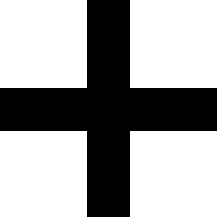
It doesn't matter whether you asign yang to the horizontal bar & yin to the vertical, or vice versa; the point is in the cross we have opposites in dynamic tension just as with the yin/yang symbol. If we for the sake of argument assign yin to the horizontal bar, then we can rotate the cross 1 time & the yin is now the vetical bar. Rotate it 1 time again & yin is again the horizontal. Rotate it 1 time again (3 times from the start) & yin is again the vertical. & so on.
Imagine the cross clicking around like the barrier in a toll-gate:
"13. Enter ye in at the strait gate: for wide is the gate, & broad is the way, that leadeth to destruction, & many there be which go in thereat:
14. Because strait is the gate, & narrow is the way, which leadeth unto life, & few there be that find it."
- Matthew, Ch.7
Now we can consider a list of opposites which can constitute yin on the one hand & yang on the other, & vice versa. Note that the terms in each particular pair of polarities are not neatly equivalent with all the others: it is not the case that the term on the left always equals yin or the term on the right always equals yang. No preference is expressed here for either term in each polarity. Each individual pair of polarities could be written the other way round: & in fact they will reverse as described above if you move round the cross 1 place or 3 places. The polarities here mentioned are some of the almost infinite cycles of which the Universe is composed. The list is intended to be illustrative not exhaustive: feel free to add your own.
good/evil night/day past/future
known/unknown morning/evening hot/cold
open/hidden winter/summer fast/slow
attractive/repulsive spring/autumn in/out
white/black easy/hard start/end
red/green empty/full earth/sky
asleep/awake dirty/clean youth/age
dream/reality low/high mad/sane
intuition/reason down/up light/dark
thick/thin left/right cat/dog
fresh/rotten unconscious/conscious wisdom/folly
top/bottom sun/moon breathe out/breathe in
female/male heaven/hell eat/shit
have/lack past/present right/wrong
here/there present/future right/left
potent/impotent lost/found free/captive
well/ill good/bad short/long
love/hate God/Devil big/small
Love/Strife 0/1 grail/lance
absence/presence expansion/contraction diastole/systole
fat/thin favourable/adverse positive/negative
wet/dry permitted/forbidden hard/soft
clear/obscure valuable/worthless certain/doubtful
tall/short rich/poor potential/actual
heavy/light concrete/abstract truths/lies
blunt/sharp hope/despair apposite/irrelevant
alive/dead concentrated/diffuse is/is not
yes/no
The second image Endless Rhythm reminds me of is the caduceus. This is a very ancient symbol of which, like many such, the ultimate origin is unknown. The word caduceus is Latin derived from the Greek karykeion, meaning a herald's staff (from the Greek keryx = a herald.) Hermes held a caduceus because he was the messenger of the gods; therefore in Roman mythology, so did Mercury. I am not concerned here with the representation or meaning of the caduceus in classical antiquity: rather with how this symbol came to be used in alchemy, especially in the early modern period. Here is a modern rendition of a caduceus:

You can see it consists of two intertwining snakes around a staff which is surmounted by a set of wings. The pattern of the intertwining snakes echo the three cirles of Endless Rhythm: this is also another case in which we have opposites in dynamic tension,as in the yin/yang sign & the cross.
Mercury was tremendously important to the Alchemists, in fact it was a sine qua non: not the chemical element mercury as we know it today, but philosophical mercury. As Lyndy Abraham explains in A Dictionary of Alchemical Imagery [exact details of works referred to will be found in the bibliography at the end of this piece]:
"Mercurius is present everywhere & at all times during the opus. From the dark chthonic beginnings of the opus to the divine, triumphant completion, Mercurius is not only the prima materia (the 'mother' of metals) which is sought at the beginning of the work, but also the ultima materia (the philospher's stone), the goal of his own transformation. Mercurius is not only the matter of the work but stands also for all the processes to which this materia is subjected. He is simultaneously the matter of the work, the process of the work, & the agent by which all this is effected."
- p.125
Let us now look at some depictions of the caduceus in alchemical texts:
 |
| Emblema X from Atalanta Fugiens (1618) by Michael Maier. It is captioned: "Da ignem igni Mercurium Mercurio & sufficit tibi. Give fire to fire, Mercury to Mercury, and it suffices thee." |

Illustration to The Twelve Keys by Basil Valentine from Michael Maier's Tripus Aureus (1618). Klossowski de Rola's [see Bibliography] gloss on this image is as follows: "The contenders (Fixed and Volatile) are seperated and reconciled in the person of Philosophick Mercury or Twofold Mercury - so called to differentiate it from the first Dissolvent which is obtained in the First Work. The youthful god's nudity indicates the absence of impurities and the crown his nobility. The double Caduceus coupled with the Sun and the Moon on either side shows his twofold power. The wings in the foreground designate the goal of the operation: the Volatization of the pure portions of the Fixed. The Snake on the sword indicates the Dissolvent, and the Eagle on the other the means to be used."
 |
| This is captioned De cavernis metallorum occultus est, qui Lapis est venerabilis. HERMES. From Le Triomphe Hermetique (1689) by Alexandre Toussaint de Limojon de Saint-Didier. Klossowski de Rola comments "'In the cavern of metals is hidden that Stone which is venerable. (HERMES)'. The Stone of the Philosophers, the metallic Earth, when identified, is extracted from the mine, purified & dissolved. The first Mercury is obtained, then the second or Philosophick Mercury symbolized by the entwined Snakes; next in order comes Sulphur, which is then elaborated into the Perfection of the Phoenix and crowned by the Triple Crown."
|

Ouroboros is Greek, literally 'tail-devouring', from oura a tail, & boraein to eat. In a brilliant marginal note in his The Alchemy Reader, Stanton J. Linden has this to say about the ouroboros:
"One of alchemy's most ancient symbols, the tail-biting serpent has many significations: e.g., the All, the unity of matter, eternity, rejuvenation, the circular nature of the alchemical process with the interconvertibility of the elements; and . . . Mercurius, the agent of transformation that both kills (or is killed) and restores."
- p.65
As Jung writes in Psychology & Alchemy :
"The dragon is probably the oldest pictorial symbol in alchemy of which we have documentary evidence. It appears as the uroboros, the tail-eater, in the Codex Marcianus, which dates from the 11th c. or the 12th c., together with the legend: en to pan (the One, the All). Time & again the alchemists reiterate that the opus proceeds from the one & leads back to the one, that it is a sort of circle like a dragon biting its own tail." - p.293, par.404
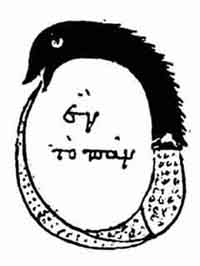 |
| This is the ouroboros from the Codex Marcianus which Jung is referring to. |
 |
| You can see the ouroboros in the centre of this page from Pandora (1582) by Hieronymus Reusner. |
"The alchemists were fond of picturing their opus as a circulatory process, as a circular distillation or as the ouroboros, the snake biting its own tail, & they made innumerable pictures of this process."
- Jung, Aion, p.264, par.418

| Emblema XIV from Atalanta Fugiens (1618) by Michael Maier. Captioned Hic est Draco caudam suam devorans. Klossowski de Rola comments: "'Here is the Dragon that devours his own tail'. This Dragon, Ouroboros, is perhaps the oldest hermetick hieroglyph, symbolizing the Unity of Matter & the Subject of the Wise; or more precisely the Mercury of the Wise, in which, assert the Philosophers, everything is found: 'From the One to the One by the One.' Roob [see Bibliography] comments: "The ancients, Maier writes, saw the Ouroboros ring both as "the change & the return of the year" & as the beginning of the Work in which the poisonous, moist dragon's tail is consumed. When the dragon has completely sloughed its skin, like the snake, the supreme medicine has risen from its poison." |
". . . the double nature of Mercurius, which shows itself most clearly in the Uroboros, the dragon that devours, fertilises, begets, slays & brings itself to life again. Being hermaphroditic, it is compounded of opposites & is at the same time their uniting symbol [my emphasis]: at once deadly poison, basilisk, scorpion, panacea & saviour."
- p.371-2, par.460
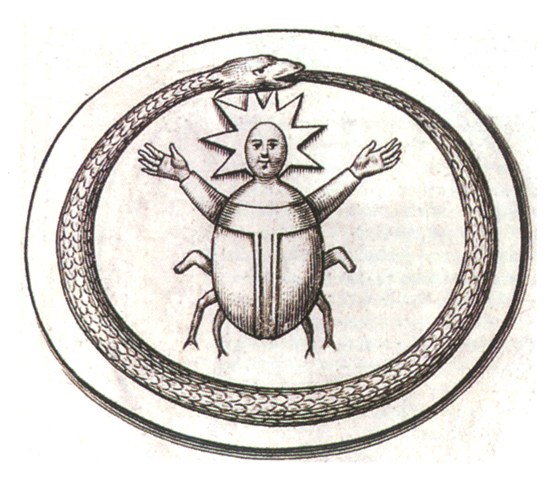 |
| From Abraxas en Apistopistus (1657) by Johannes Macarius. Roob comments: "Both the Ouroboros & the Scarab are an expression of the 'hen to pan', the eternal transformation of the Ever Unchanging.'" |
BIBLIOGRAPHY
ISBNs are given as 10 digits, except where the book is recent enough to have a 13 digit ISBN.
Works consulted in the preparation of this piece
Abraham, Lyndy A Dictionary of Alchemical Imagery CUP, 1998 ISBN 0521000009
Cave, Terence How To Read Montaigne Granta Books, 2007 9781862079441
Jung, Carl Aion Routledge, 1991
Collected Works vol.9 part II
0415064767
,, ,, Psychology & Alchemy Routledge, 2nd ed. 1968
vol. 12
0415034523
,, ,, Alchemical Studies PUP, 1967
vol.13
0691081499
,, ,, Mysterium Coniunctionis PUP, 1963
vol.14
0691018162
Klossowski de Rola, Stanislaus The Golden Game:
Alchemical Engravings of the 17th century
Thames & Hudson, 1988
0500279810
Linden, Stanton J. The Alchemy Reader CUP, 2003 0521796628
Roob, Alexander Alchemy & Mysticism Taschen, 1997 382288653X
Further reading on the subject of Alchemy
Burckhardt, Titus Alchemy Fons Vitae, 1997 1887752110
Coudert, Allison Alchemy Wildwood House, 1980 0704504138
Gilchrist, Cherry The elements of Alchemy Element, 1991 1852302054
Thompson, C.J.S. Alchemy & Alchemists Dover, 2002 0486421104