 | |
|
My father had a most appropriate response to reading Bulletins , chiefly Rochester, Jim Morrison & the Uses of Obscenity I would think (you can find that post by clicking on the label 'obscenity' at the bottom of this page). He sent me a terrific little book I had never heard of: Lars Porsena, or the Future of Swearing by Robert Graves. It was published by Kegan Paul. Someone has pencilled '1936' in the front, but I showed it to Alex (my friend who is a 2nd-hand book dealer), who was as intrigued as me, & a little research showed us it was probably published in 1927. It is an essay on the history, nature & possible future of swearing. Its title, at first sight rather odd, comes from two factors. First, it was written as part of a series of such essays called Today & Tomorrow, & you can see adverts for others in the series in the back of the book. The titles almost all follow that formula:- [Classical reference: what the essay is about] e.g. Daedalus, or Science & the Future ; Thrasymachus, the Future of Morals ; etc. etc. You get the idea. Second, Graves has chosen Lars Porsena in particular because it is a reference to the 1st line of Macaulay's poem Horatius (from his Lays of Ancient Rome , hugely popular in the 19th c. - Lars Porsena was an Etruscan king who attacked Rome in its very earliest days of being a Republic):
"Lars Porsena of Clusium, by the Nine Gods he swore
That the great house of Tarquin should suffer wrong no more.
By the Nine Gods he swore it, & named a trysting day,
And bade his messengers ride forth,
East & West & South & North,
To summon his array."
I want to share with you an excerpt from this book by Graves which I found particularly funny: then Graves' poem The Persian Version; then the last paragraph of Lars Porsena &c. ; & to finish, an account by a soldier who was at the Battle of Waterloo of what it was like.
So - the excerpt -
"The ingenious General G------r, so remarkable an artist in swearing that he must one day earn a paragraph in the revised D.N.B., used this form of profanity with the happiest effect. Once, when inspecting the famous "Z" Battery of the Royal Horse Artillery, he was dissatisfied with its response to his order "Dismount !" He bellowed out: "Now climb back again, you pack of consumptive little Maltese monkeys !" "Z" Battery complained to Headquarters of this affront, & General G-----r was in due course asked for his explanation & apology. He gave it briefly as follows:
'Sir,
I have the honour to report that, on the occasion to which I am referred, my order to dismount was obeyed in so slovenly a fashion that for the moment I was deceived. I concluded that I was actually assisting at a performance by a troupe of little Maltese monkeys, amusing enough but crippled by disease. I tender my apologies to all ranks of "Z" Battery for my mistake.
I have the honour to be, Sir,
Your obedient servant,
J. G-----r
Major-General '"
- Lars Porsena, or the Future of Swearing, p;14-15
The Persian Version
Truth-loving Persians do not dwell upon
The trivial skirmish fought near Marathon.
As for the Greek theatrical tradition
Which represents that summer's expedition
Not as a mere reconnaissance in force
By three brigades of foot and one of horse
(Their left flank covered by some obsolete
Light craft detached from the main Persian fleet)
But as a grandiose, ill-starred attempt
To conquer Greece - they treat it with contempt;
And only incidentally refute
Major Greek claims, by stressing what repute
The Persian monarch and the Persian nation
Won by this salutary demonstration:
Despite a strong defence and adverse weather
All arms combined magnificently together.
[N.B. The Battle of Marathon (490 BCE) was an utter disaster for the Persians & a decisive victory for the Greeks.]
"Lars Porsena of Clusium, by the Nine Gods he swore
That the great house of Tarquin should suffer wrong no more.
By the Nine Gods he swore it, & named a trysting day,
And bade his messengers ride forth,
East & West & South & North,
To summon his array."
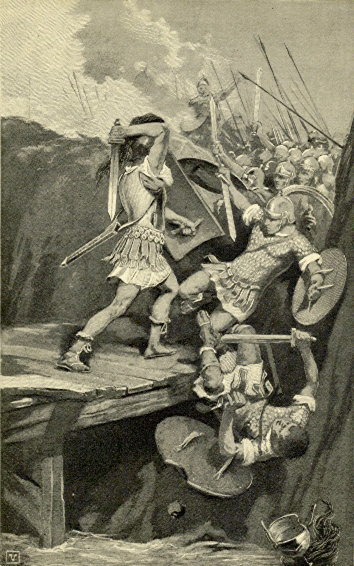 |
| Horatius defending the bridge into Rome against the invading Etruscans |
I want to share with you an excerpt from this book by Graves which I found particularly funny: then Graves' poem The Persian Version; then the last paragraph of Lars Porsena &c. ; & to finish, an account by a soldier who was at the Battle of Waterloo of what it was like.
-----------------------------------------°----------------------------------------
So - the excerpt -
"The ingenious General G------r, so remarkable an artist in swearing that he must one day earn a paragraph in the revised D.N.B., used this form of profanity with the happiest effect. Once, when inspecting the famous "Z" Battery of the Royal Horse Artillery, he was dissatisfied with its response to his order "Dismount !" He bellowed out: "Now climb back again, you pack of consumptive little Maltese monkeys !" "Z" Battery complained to Headquarters of this affront, & General G-----r was in due course asked for his explanation & apology. He gave it briefly as follows:
'Sir,
I have the honour to report that, on the occasion to which I am referred, my order to dismount was obeyed in so slovenly a fashion that for the moment I was deceived. I concluded that I was actually assisting at a performance by a troupe of little Maltese monkeys, amusing enough but crippled by disease. I tender my apologies to all ranks of "Z" Battery for my mistake.
I have the honour to be, Sir,
Your obedient servant,
J. G-----r
Major-General '"
- Lars Porsena, or the Future of Swearing, p;14-15
---------------------------------------------°----------------------------------------------
 |
| Robert Graves |
The Persian Version
Truth-loving Persians do not dwell upon
The trivial skirmish fought near Marathon.
As for the Greek theatrical tradition
Which represents that summer's expedition
Not as a mere reconnaissance in force
By three brigades of foot and one of horse
(Their left flank covered by some obsolete
Light craft detached from the main Persian fleet)
But as a grandiose, ill-starred attempt
To conquer Greece - they treat it with contempt;
And only incidentally refute
Major Greek claims, by stressing what repute
The Persian monarch and the Persian nation
Won by this salutary demonstration:
Despite a strong defence and adverse weather
All arms combined magnificently together.
[N.B. The Battle of Marathon (490 BCE) was an utter disaster for the Persians & a decisive victory for the Greeks.]
------------------------------------------------°-----------------------------------------------
 | |
|
In the very last paragraph of Lars Porsena &c., after a brief four page analysis of James Joyce's Ulysses - the excellence or otherwise of which I am unable to comment on since I haven't read Ulysses, which fact is projected to be the subject of a future Bulletin - Graves suddenly makes some very insightful remarks about Shakespeare's Sonnets, which I want to reproduce here. This is the last paragraph in full:
"It is quite right that Ulysses should be censored since its chief public in England could at the best of times be only an obscene one: and it is not an obscene book, but on the contrary perhaps the least obscene book every published: that is why it is censored. And there is every reason why Shakespeare's sonnets should be censored at the same time, and more strictly, because the public blinds its eyes to the painful history that the sequence gives and makes it 'extravagant flattery of a patron' or 'an academic exercise'. Joyce is read as obscene instead of successfully past obscenity: Shakespeare instead of being read as pure lust is not even read as lusting."
This reminds me forcibly of Ted Hughes' brilliant description of the Sonnets in his Shakespeare & the Goddess of Complete Being :
"This 'total, unconditional love', wilfully subjecting itself to hardship & pain, worshipping the physical beloved (whether she likes it or not) as an incarnation of the Divine, animates the troubadours & Dante. Something of the same burns in the Sonnets, but with a difference, a rawness, an untheologized, surprised, private pain."
- Shakespeare & the Goddess of Complete Being (ISBN 0571166040), p.60
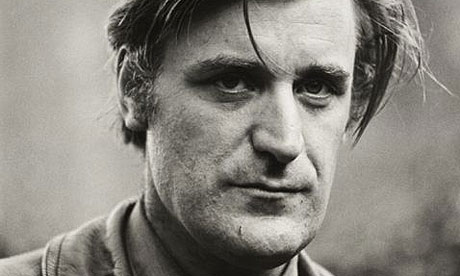 |
| Ted Hughes (1930-1998) |
----------------------------------------------°---------------------------------------------
To finish, an account of what it was like to be at Waterloo by a soldier who was there. This is quoted in The Napoleonic Wars 1803-1815 by David Gates, which is where I found it; it comes originally from Adventures in the Rifle Brigade & Random Shots from a Rifleman by Captain Sir John Kincaid. The quote in question comes at the end of the following; Gates writes:
"Even if they were in a position to enjoy a bird's-eye view of a particular engagement - & very few of them ever were, if only because of the sheer size of Napoleonic battles - most ordinary soldiers were far too busy trying to keep themselves & their comrades alive to worry about the grander affairs going on around them. As an acquaintance of Captain Kincaid, the celebrated diarist, stated about Waterloo (or, at least, so Kincaid assures us):
'I'll be hanged . . . if I know anything at all about the matter, for I was all day trodden in the mud & galloped over by every scoundrel who had a horse; &, in short . . . I only owe my existence to my insignificance.'"

